

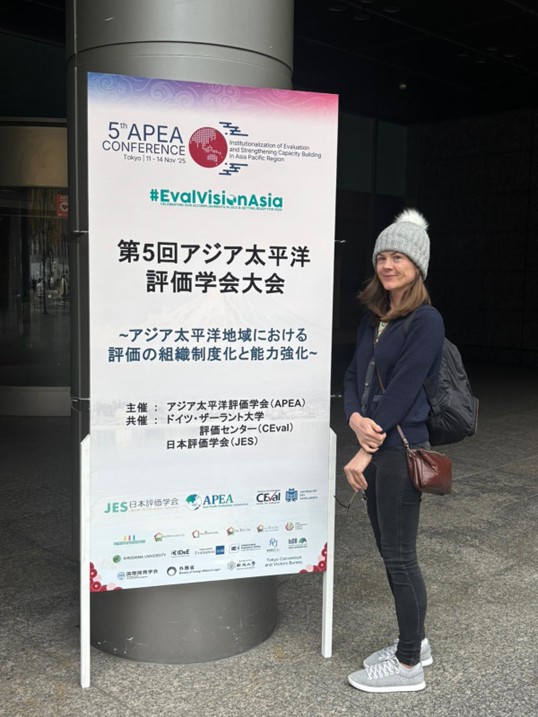
The APEA is an association that brings together evaluators from across Asia and the Pacific. Founded in 2012, it has developed a strong identity and has played an important role in highlighting evaluation as a distinct field within the region. Its 2025 conference was the fifth to date, centred on the theme ‘Institutionalisation of evaluation and strengthening capacity building in the Asia-Pacific region,’ and was held in Tokyo from 10–14 November. With support from the Whakauae Pae Tawhiti scholarship, Aneta was able to attend and present findings from her doctoral studies.
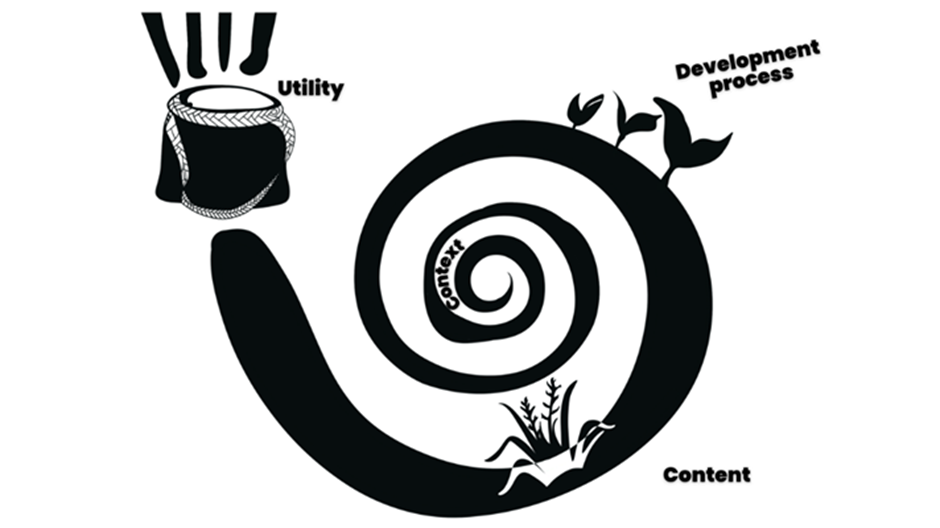
Aneta’s presentation, entitled ‘Supporting Localised Evaluation Practice through Indigenous Evaluation Frameworks,’ drew on the core insights from her PhD research, which focused on the development of Indigenous Evaluation Frameworks. She shared a model developed as part of her doctoral work, a simple visual created in collaboration with the Design Lead of Whakauae, Tom Johnson. The model comprises four key areas considered during evaluation framework development: context, development process, content, and utility. Aneta explored each area in depth, highlighting what her research revealed and offering guiding questions to support communities seeking to create their own grounded, culturally-aligned evaluation frameworks.
For Aneta, the conference was not only an opportunity to showcase her doctoral research but also a chance to engage in conversations about what it truly means for Indigenous communities to set the agenda for their own evaluation practices through the development of our own evaluation tools.
The wider conference programme featured speakers from across the globe, including Germany, where presenters examined the relationship between government systems and evaluation, and speakers from Sri Lanka and Bhutan, who emphasised the value of listening closely to community aspirations. Their presentations explored how local knowledge is an important consideration in areas such as transportation, ensuring responsiveness to culture and gender norms, and strengthening the voices of Indigenous peoples in land conservation efforts.
Overall, Aneta is deeply grateful for the opportunity to connect with evaluators from around the world. Her attendance at this conference, made possible by Whakauae, has allowed her to begin her research dissemination efforts at a global level.

The APEA is an association that brings together evaluators from across Asia and the Pacific. Founded in 2012, it has developed a strong identity and has played an important role in highlighting evaluation as a distinct field within the region. Its 2025 conference was the fifth to date, centred on the theme ‘Institutionalisation of evaluation and strengthening capacity building in the Asia-Pacific region,’ and was held in Tokyo from 10–14 November. With support from the Whakauae Pae Tawhiti scholarship, Aneta was able to attend and present findings from her doctoral studies.
Aneta’s presentation, entitled ‘Supporting Localised Evaluation Practice through Indigenous Evaluation Frameworks,’ drew on the core insights from her PhD research, which focused on the development of Indigenous Evaluation Frameworks. She shared a model developed as part of her doctoral work, a simple visual created in collaboration with the Design Lead of Whakauae, Tom Johnson. The model comprises four key areas considered during evaluation framework development: context, development process, content, and utility. Aneta explored each area in depth, highlighting what her research revealed and offering guiding questions to support communities seeking to create their own grounded, culturally-aligned evaluation frameworks.
For Aneta, the conference was not only an opportunity to showcase her doctoral research but also a chance to engage in conversations about what it truly means for Indigenous communities to set the agenda for their own evaluation practices through the development of our own evaluation tools.
The wider conference programme featured speakers from across the globe, including Germany, where presenters examined the relationship between government systems and evaluation, and speakers from Sri Lanka and Bhutan, who emphasised the value of listening closely to community aspirations. Their presentations explored how local knowledge is an important consideration in areas such as transportation, ensuring responsiveness to culture and gender norms, and strengthening the voices of Indigenous peoples in land conservation efforts.
Overall, Aneta is deeply grateful for the opportunity to connect with evaluators from around the world. Her attendance at this conference, made possible by Whakauae, has allowed her to begin her research dissemination efforts at a global level.


