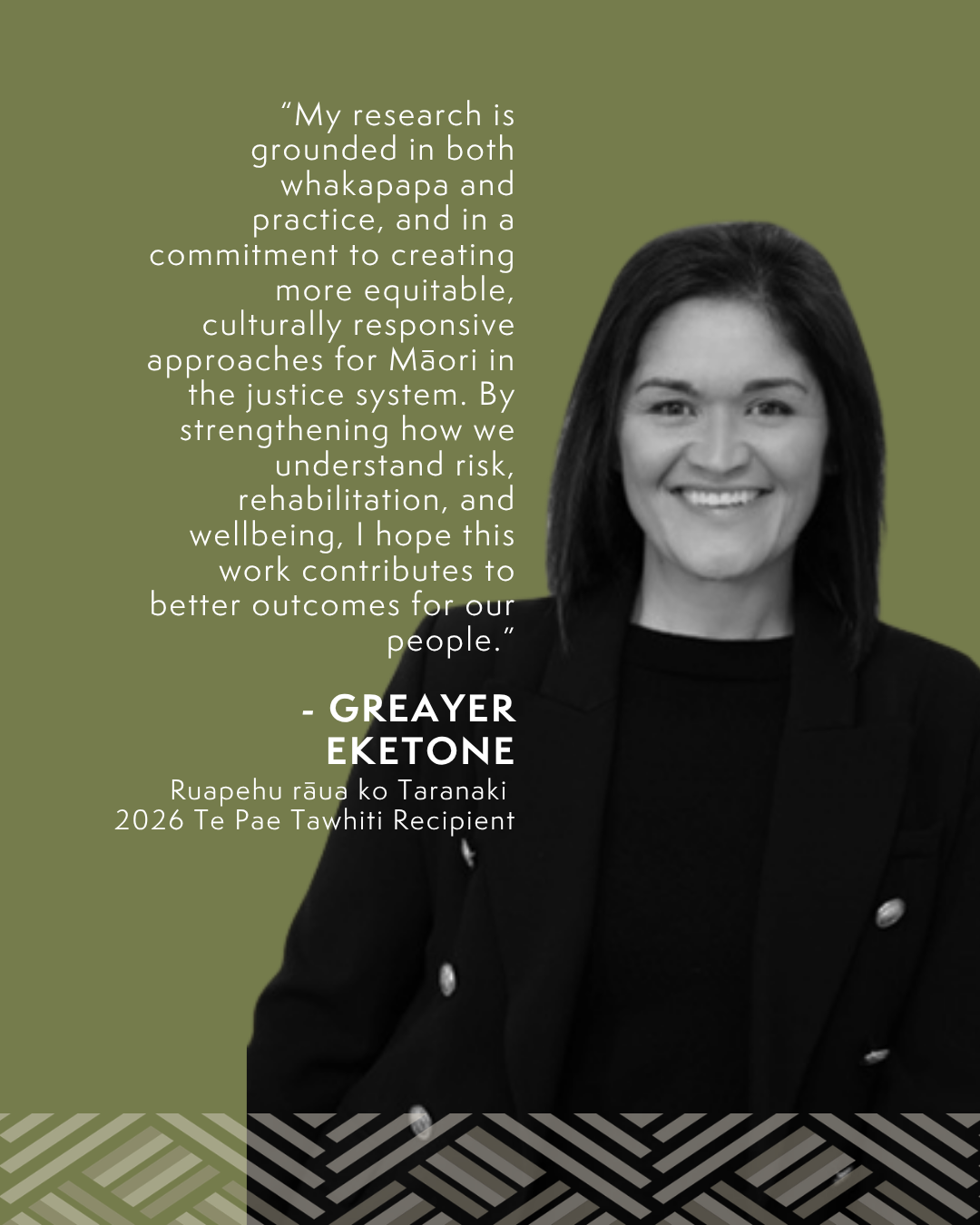
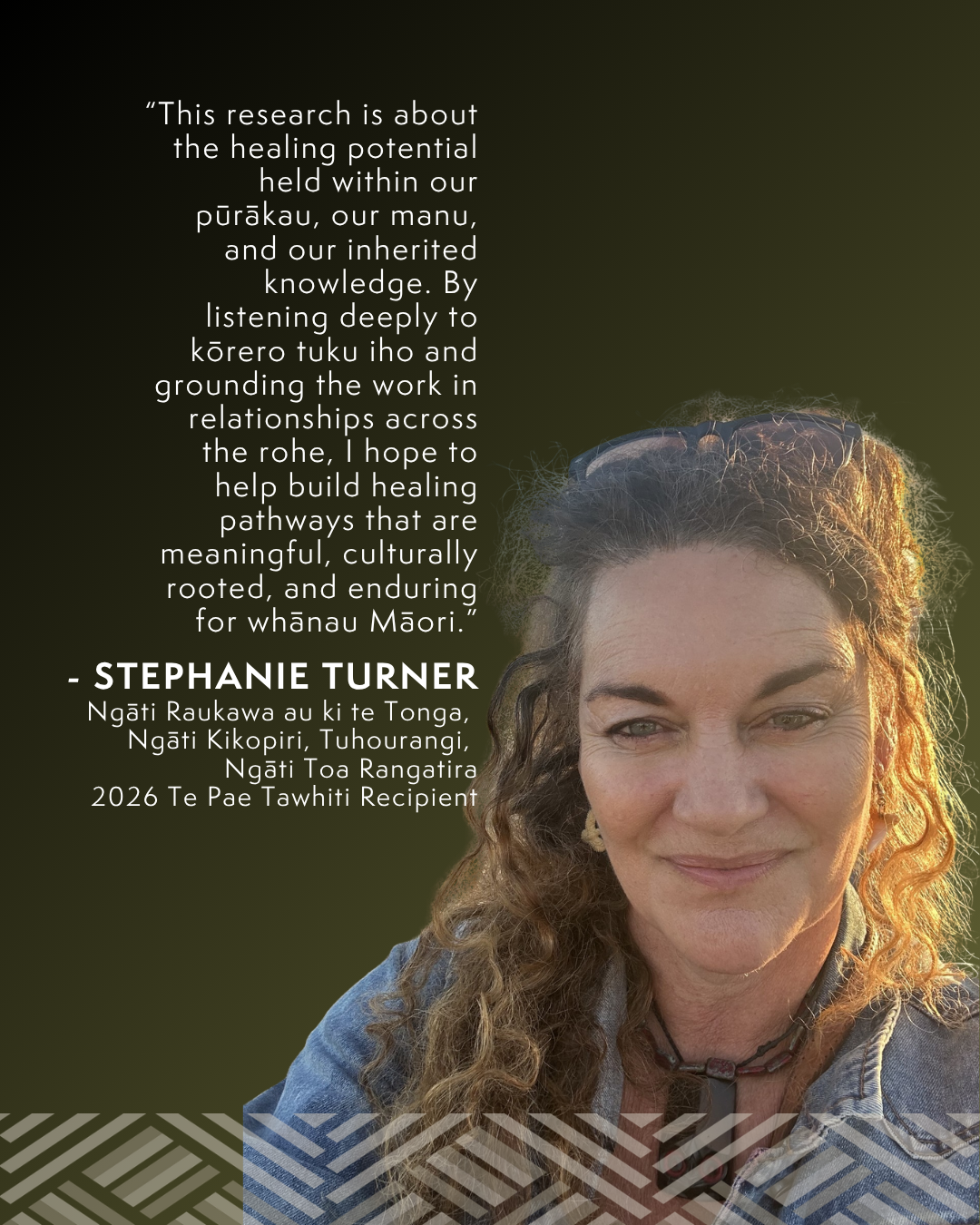
We are proud to celebrate our 2026 Te Pae Tawhiti scholarship recipients, Greayer Eketone and Stephanie Turner. Through their research, both scholars are contributing knowledge that is deeply grounded in whakapapa, community, and a commitment to improving outcomes for whānau Māori. Their work reflects the strength and vision of Māori-led research, and the many ways mātauranga Māori continues to guide pathways of healing, justice, and wellbeing for future generations.
He uri āhau i raro ngā maunga e rua, ā ko Ruapehu rāua ko Taranaki. Ēngari, kei te rohe o Ngāti Apa te whānau o tōku pāpā e tipu ake ana. Ko Greayer Eketone ahau.
My grandmother wished for her mokopuna to navigate both Māori and Pākehā worlds, and my parents prioritised my education. These foundations underpin my aspirations.
My master's and doctoral research examine what helps Māori move away from offending behaviour, and how we can improve predictions of reoffending risk in Corrections. I have been evaluating a tool that aims to make these assessments more equitable for Māori. Understanding Māori cultural strengths could reduce bias in reoffending prediction and support better, culturally appropriate ways to rehabilitate our people who have harmed others. After my research, I plan to work as a clinical psychologist, enhancing risk assessment, rehabilitation, and psychological interventions within Ara Poutama, while promoting bicultural practice through a Te Ao Māori lens.
My research is grounded in both whakapapa and practice and is driven by a commitment to addressing the inequities facing our people, particularly the overrepresentation of Māori in the justice system and the complex relationship between health and offending behaviour. As a clinical psychologist working in the justice setting, I have seen the urgent need for culturally responsive, equitable approaches that lead to better outcomes for Māori. My research is critical in contributing to the development of more accurate and culturally appropriate methods of recidivism risk assessment, with the aim of strengthening rehabilitation and psychological interventions through a Te Ao Māori lens.
The Pae Tawhiti scholarship provides vital access to Māori academic supervision, an opportunity that has previously been limited. Through this guidance, I intend to ensure my rangahau is both culturally grounded and academically rigorous. This scholarship also alleviates financial constraints, allowing me to dedicate focused attention to my thesis. In doing so, I aim to generate knowledge that contributes to improved outcomes for Māori within the corrections system, with a particular emphasis on reducing harm and enhancing wellbeing.
Stephanie Turner (Ngāti Raukawa au ki te Tonga, Ngāti Huia, Ngāti Kikopiri, Tuhourangi, Ngāti Toa Rangatira), is a student at Te Whare Wānanga ō Awanuiārangi, undertaking a PhD in Indigenous Development & Advancement, her research focuses on applications of pūrākau ā manu as rongoā, and the possible applications of this as land based therapy within health and community wellness settings, and hapu and iwi contexts.
Her reserach is deeply informed by her relationships across the rohe and aligns to the work of Whakaue research in seeking to build wellbeing options for whānau Māori. Stephanie completed a diploma in Oranga Hinengaro at Te Wānanga ō Raukawa in the late 1990’s while working as a Family Therapist within Kaupapa Māori Mental Health specialist services. It was a time of innovation where pūrākau as therapy and Mahi ā Atua began, working alongside clinical colleagues at that time who led the developement, Dr Diana Kopua (nee Rangihuna), Lisa Cherrington and Peta Ruha. Stephanie used mahi atua with children and young people incorporating it into land based therapy at thst time. She went on to complete her MA which researched Maōri worldviews of Art as Therapy.
Stephanie put her PhD research on hold while her oldest daughter, Te Ākau, became unwell and underwent intense cancer treatment for 3 plus years. The pūrākau ō Maui Tikitiki ā Taranga with his abilities as a shape shifter and encounters with both Mahuika and Hine nui te Pō allowed her whānau to discuss mortality and death and dying in ways that were strangely comforting. Te Ākau has a giant Kāhū carved in marble as her stone at Ahipanepane urupā in the Wairarapa, the Kāhū has explosion marks burnt into its back from Mahuika and acknowledges that Maui even with all his skills and magic could not conquer or escape Hine nui te Pō - death. These pūrākau were important for Stephanie and her whānau and provide some context in terms of the depth of motivation for researching pūrākau as medicine /rongoā. Centralising manu is twofold, they feature in many of our pūrākau. Their flights and presence in pūrākau pervade heavens and te ao kikokiko (the physical world), and some manu appear fluid in this regard, traversing both, and as conveyers of messages in both.
Stephanie’s research includes the collation of kōrero tuku iho through interviews from across the rohe of Rangitīkei, Kāpiti, Te Ūpoko o Te ika and Wairarapa pertaining to manu (birds), the whakapapa orokohanga (legacy stories and genealogies) of manu; our human connection and experiences with them, our knowledge from within this time, and most importantly the possible uses of this knowledge as rongoā. Pūrākau as therapy and pūrākau ā manu as land-based therapy. She hopes that this research will contribute to building other healing options for whānau Māori in community or iwi /hapu settings.
Additionally, this research uses pūrākau as methodology building on the knowledge of Kaupapa Māori methodologies. Whakapapa orokohanga ā manu (Maōri creation genealogies of birds), like te rerenga a manu, (the flight paths of migratory birds), these pūrākau also convey navigation opportunities in this time and space, they convey our connections as tangata o Aotearoa in and with our Pacific whanaunga, ngā tangata o le moana building on therapies that relate and speak to the diversity of our mokopuna who are Kotuitanga, of both Māori and Pacific descent.
“The Pae Tawhiti scholarship is hugely significant for our whānau as I have stepped away from employment to complete this research, the financial support from Whakauae is fundamental to my ability to focus and uphold my tikanga as a Māori researcher as it enables me to give the required time and mana to tangata pukenga /Kai Korero across the rohe and to wānanga with them. On top of this is a feeling of immense gratitude for the for the day to day support from the Whakauae whānau, having access to Māori research knowledge and expertise is an incredible privilege. I think PhD research can be a lonely and isolating affair, having the korowai of Whakauae around me, their knowledge and research experiences, their support as expert Māori researchers that always place whānau Māori at the centre of any research is critical to this rangahau being of value in the future for whānau. The Pae Tawhiti scholarship significantly contributes to my ability to conduct my research in 2026 and to meet a hand in midway 2027”.
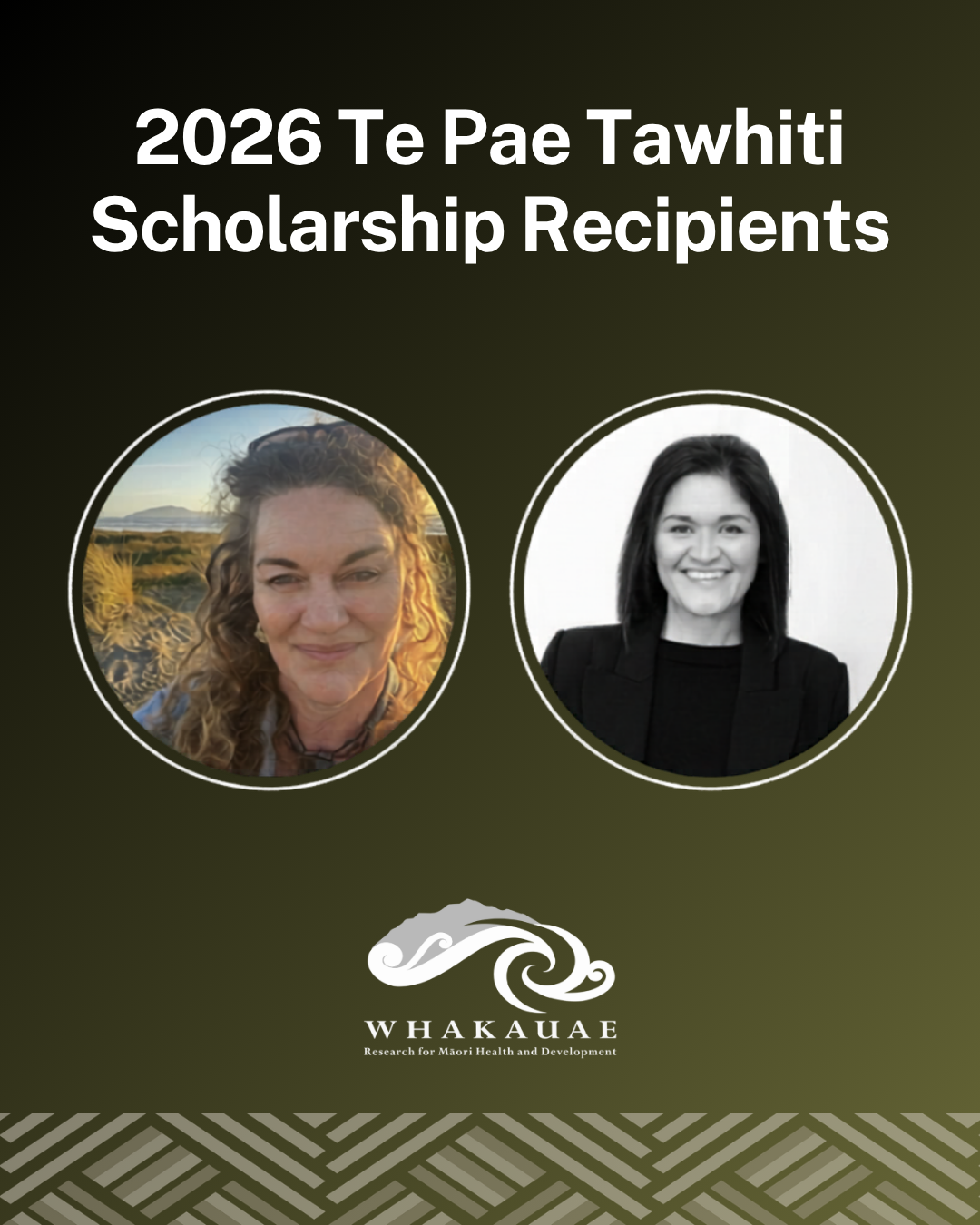
We are proud to celebrate our 2026 Te Pae Tawhiti scholarship recipients, Greayer Eketone and Stephanie Turner. Through their research, both scholars are contributing knowledge that is deeply grounded in whakapapa, community, and a commitment to improving outcomes for whānau Māori. Their work reflects the strength and vision of Māori-led research, and the many ways mātauranga Māori continues to guide pathways of healing, justice, and wellbeing for future generations.
He uri āhau i raro ngā maunga e rua, ā ko Ruapehu rāua ko Taranaki. Ēngari, kei te rohe o Ngāti Apa te whānau o tōku pāpā e tipu ake ana. Ko Greayer Eketone ahau.
My grandmother wished for her mokopuna to navigate both Māori and Pākehā worlds, and my parents prioritised my education. These foundations underpin my aspirations.
My master's and doctoral research examine what helps Māori move away from offending behaviour, and how we can improve predictions of reoffending risk in Corrections. I have been evaluating a tool that aims to make these assessments more equitable for Māori. Understanding Māori cultural strengths could reduce bias in reoffending prediction and support better, culturally appropriate ways to rehabilitate our people who have harmed others. After my research, I plan to work as a clinical psychologist, enhancing risk assessment, rehabilitation, and psychological interventions within Ara Poutama, while promoting bicultural practice through a Te Ao Māori lens.
My research is grounded in both whakapapa and practice and is driven by a commitment to addressing the inequities facing our people, particularly the overrepresentation of Māori in the justice system and the complex relationship between health and offending behaviour. As a clinical psychologist working in the justice setting, I have seen the urgent need for culturally responsive, equitable approaches that lead to better outcomes for Māori. My research is critical in contributing to the development of more accurate and culturally appropriate methods of recidivism risk assessment, with the aim of strengthening rehabilitation and psychological interventions through a Te Ao Māori lens.
The Pae Tawhiti scholarship provides vital access to Māori academic supervision, an opportunity that has previously been limited. Through this guidance, I intend to ensure my rangahau is both culturally grounded and academically rigorous. This scholarship also alleviates financial constraints, allowing me to dedicate focused attention to my thesis. In doing so, I aim to generate knowledge that contributes to improved outcomes for Māori within the corrections system, with a particular emphasis on reducing harm and enhancing wellbeing.
Stephanie Turner (Ngāti Raukawa au ki te Tonga, Ngāti Huia, Ngāti Kikopiri, Tuhourangi, Ngāti Toa Rangatira), is a student at Te Whare Wānanga ō Awanuiārangi, undertaking a PhD in Indigenous Development & Advancement, her research focuses on applications of pūrākau ā manu as rongoā, and the possible applications of this as land based therapy within health and community wellness settings, and hapu and iwi contexts.
Her reserach is deeply informed by her relationships across the rohe and aligns to the work of Whakaue research in seeking to build wellbeing options for whānau Māori. Stephanie completed a diploma in Oranga Hinengaro at Te Wānanga ō Raukawa in the late 1990’s while working as a Family Therapist within Kaupapa Māori Mental Health specialist services. It was a time of innovation where pūrākau as therapy and Mahi ā Atua began, working alongside clinical colleagues at that time who led the developement, Dr Diana Kopua (nee Rangihuna), Lisa Cherrington and Peta Ruha. Stephanie used mahi atua with children and young people incorporating it into land based therapy at thst time. She went on to complete her MA which researched Maōri worldviews of Art as Therapy.
Stephanie put her PhD research on hold while her oldest daughter, Te Ākau, became unwell and underwent intense cancer treatment for 3 plus years. The pūrākau ō Maui Tikitiki ā Taranga with his abilities as a shape shifter and encounters with both Mahuika and Hine nui te Pō allowed her whānau to discuss mortality and death and dying in ways that were strangely comforting. Te Ākau has a giant Kāhū carved in marble as her stone at Ahipanepane urupā in the Wairarapa, the Kāhū has explosion marks burnt into its back from Mahuika and acknowledges that Maui even with all his skills and magic could not conquer or escape Hine nui te Pō - death. These pūrākau were important for Stephanie and her whānau and provide some context in terms of the depth of motivation for researching pūrākau as medicine /rongoā. Centralising manu is twofold, they feature in many of our pūrākau. Their flights and presence in pūrākau pervade heavens and te ao kikokiko (the physical world), and some manu appear fluid in this regard, traversing both, and as conveyers of messages in both.
Stephanie’s research includes the collation of kōrero tuku iho through interviews from across the rohe of Rangitīkei, Kāpiti, Te Ūpoko o Te ika and Wairarapa pertaining to manu (birds), the whakapapa orokohanga (legacy stories and genealogies) of manu; our human connection and experiences with them, our knowledge from within this time, and most importantly the possible uses of this knowledge as rongoā. Pūrākau as therapy and pūrākau ā manu as land-based therapy. She hopes that this research will contribute to building other healing options for whānau Māori in community or iwi /hapu settings.
Additionally, this research uses pūrākau as methodology building on the knowledge of Kaupapa Māori methodologies. Whakapapa orokohanga ā manu (Maōri creation genealogies of birds), like te rerenga a manu, (the flight paths of migratory birds), these pūrākau also convey navigation opportunities in this time and space, they convey our connections as tangata o Aotearoa in and with our Pacific whanaunga, ngā tangata o le moana building on therapies that relate and speak to the diversity of our mokopuna who are Kotuitanga, of both Māori and Pacific descent.
“The Pae Tawhiti scholarship is hugely significant for our whānau as I have stepped away from employment to complete this research, the financial support from Whakauae is fundamental to my ability to focus and uphold my tikanga as a Māori researcher as it enables me to give the required time and mana to tangata pukenga /Kai Korero across the rohe and to wānanga with them. On top of this is a feeling of immense gratitude for the for the day to day support from the Whakauae whānau, having access to Māori research knowledge and expertise is an incredible privilege. I think PhD research can be a lonely and isolating affair, having the korowai of Whakauae around me, their knowledge and research experiences, their support as expert Māori researchers that always place whānau Māori at the centre of any research is critical to this rangahau being of value in the future for whānau. The Pae Tawhiti scholarship significantly contributes to my ability to conduct my research in 2026 and to meet a hand in midway 2027”.